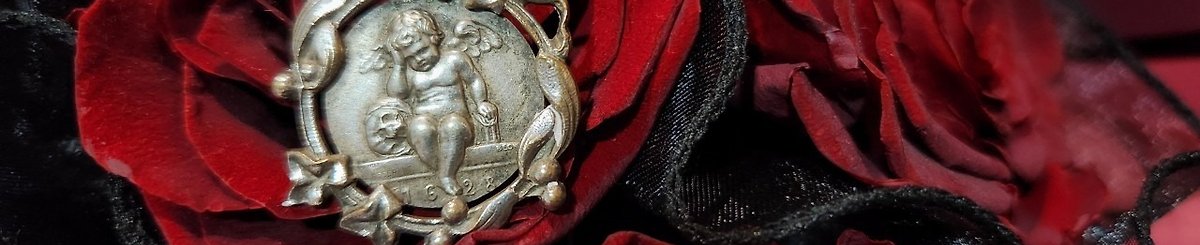

Victorian (1837-1901) heart-shaped silver brooch, acquired from an antique shop in England.
The concept of Victorian jewelry originated in Britain, referring to the jewelry styles from the reign of Queen Victoria, from 1837 to 1901. Following the end of the Georgian era, in 1837, Princess Alexandra Victoria, daughter of Prince Edward, took the throne and was crowned Queen of England, becoming the historically renowned Queen Victoria. The 63 years from this time until the Queen's death in 1901 are widely known as the Victorian era. This period significantly influenced many fields, including politics, fashion, and art, with its impact continuing to this day.
The Queen herself was very fond of wearing and collecting jewelry, which set the trend for the entire society at the time. In Victorian culture, jewelry represented a person's identity and social status, such as rank, social class, and wealth. Therefore, jewelry became a common "daily necessity" during this period. Those from the lower classes, with limited financial means, often couldn't keep up with this social trend. Furthermore, women remained the primary consumers of jewelry during the Victorian era, while men rarely wore it, instead presenting it as gifts to women they admired.
The heart symbol has been regarded as a representation of love, though its origins are untraceable. The earliest known heart-shaped motif discovered globally was found in an artifact from the Indus Valley Civilization, a fig leaf pendant. Additionally, the heart shape bears a striking resemblance to the leaves of the water lily, which was considered a symbol of fertility in ancient Indian civilizations. The seed pod of the silphium plant also closely resembles a heart shape; in ancient Roman times, this plant was used as an aphrodisiac, making it another potential origin for the modern heart symbol.
The earliest work to use the heart symbol to represent the heart is the 13th-century French love story, "Le Roman de la Poire" (The Romance of the Pear). Later, with the popularity of playing cards, the heart symbol representing the suit of hearts also gained prominence. By the 17th century, the heart symbol had become synonymous with the heart and simultaneously an emblem of love. Perhaps due to its easily recognizable, reproducible, and pleasing connotations, the heart shape has never disappeared from women's fashion since the 18th century. In the 18th century, court ladies would cut silk into heart shapes and apply them to their faces to accentuate their features. After 19th-century printers began promoting Valentine's Day cards, the heart immediately became the symbol of Valentine's Day.
A brooch, also known as a dress clip, is a piece of jewelry fastened to clothing with a clasp, or can be considered a decorative pin. Typically made of metal, it may be adorned with gemstones or enamel. It can serve purely as decoration or also function to secure clothing, such as robes, capes, or scarves. The history of brooches dates back to the Bronze Age, and their evolving forms are used in archaeology to help determine the age of artifacts. Contemporary brooches are generally worn by women. They can be pinned to the chest, or worn on the shoulder, hat, or in the hair. As brooches are relatively large pieces of jewelry, they offer considerable design freedom and are more likely to attract attention when worn. The form of a brooch integrates various customs, sentiments, and fashion elements. Commonly seen designs include orchid shapes, engagement ring shapes, ovals, fans, butterflies, musical instruments, floral and leaf motifs, ingot shapes, animal figures, leaf shapes, human figures, and abstract symbols.


รายละเอียดสินค้า
ข้อมูลสินค้า
- วัสดุสินค้า
- เงินแท้
- วิธีการผลิตสินค้า
- แฮนด์เมด
- แหล่งผลิตสินค้า
- สหราชอาณาจักร
- จุดเด่นของสินค้า
- บริการสั่งทำพิเศษเฉพาะลูกค้า
- ความนิยม
-
- ถูกชม 2,326 ครั้ง
- มี 1 คนถูกใจ
- สินค้าที่จำหน่าย
- ของเก่าวินเทจ
- รายละเอียดย่อยของสินค้า
- Victorian (1837-1901) heart-shaped silver brooch, acquired from an antique shop in England.
ค่าจัดส่งและรายละเอียดอื่นๆ
- ค่าจัดส่ง
- วิธีชำระเงิน
-
- บัตรเครดิต/เดบิด
- Alipay
- การคืนเงินและเปลี่ยนสินค้า
- อ่านรายละเอียดการคืนเงินและเปลี่ยนสินค้า
- แจ้งปัญหา
- รายงานสินค้าชิ้นนี้