
Faith as a Way of Life, a Practice of Existence
The Dajia Mazu Pilgrimage, the Baishatun Mazu Pilgrimage, walking around Taiwan to visit all Mazu temples,
painting Mazu in local villages for exhibitions, publishing the "Taiwan Mazu Calendar," inviting Mazu to ascend to Jiā míng Lake and journey through Shikoku...
What Mazu has taught me is not about worship, but about slowly experiencing and practicing the process of being human.
We are children of the sea, riding the waves with the currents,
to lands flowing with milk and honey, never forgetting the hardships of our ancestors.
I pray to you, O Holy Mother Mazu, who answers prayers instantly!
May this beautiful island be free from environmental disasters and human turmoil.
Chusstudio99, feeling lost in college, prayed to Mazu and felt a response, which led her to follow Mazu's pilgrimages, walk around Taiwan to visit Mazu temples, and create Mazu artwork for village residencies and exhibitions, publishing the "Taiwan Mazu Calendar." She also enshrined a "Ci Yi Mazu" statue and invited Mazu on travels across Taiwan, including visits to Bhutan and Japan's Shikoku. With over a decade of creation and local engagement, she has journeyed through life's footprints centered around Mazu temples.
Through her words, Zhu Zhu revisits the landscapes encountered and the paths trodden over fifteen years of accompanying Mazu. She recounts the people met and the stories woven, highlighting how faith can be a way of life and a practice of existence, both enduring and substantial.
-----
Featured Recommendation
Yin Bao-Ning / Professor and Dean, Graduate Institute of Arts Management and Cultural Policy, National Taiwan University of Arts
Endorsements
Josie / Author of "Journey Within"
Katakura Yoshifumi / Writer based in Taiwan
Yu Guo-Xin / Secretary-General, Hongya Culture Association, Chiayi City; Owner, Hongya Bookstore
Li Qian-Lang / Professor, Graduate Institute of Arts Management and Cultural Policy, National Taiwan University of Arts
Lin Mei-Rong / Adjunct Researcher, Institute of Ethnology, Academia Sinica
Hsu Ming-Chien / Deputy Executive Director, Taiwan Thousand Mile Trail Association
Susu / Huanghuang Second-Hand Bookstore
Chen Yu-Hsiu / Honorary Chairman, White Egret Educational Foundation
Chen Pi-Chun / Director, Department of Culture and Tourism, Yunlin County Government
Cheryl / Travel Writer
Dan Yen-Po / Founder, Keelung Camino
Yang Ya-Ping / Proprietor, Jian Bookstore
Cheng Yu-Chan / Proprietor, Chan Chan's Travel Story
(Sorted by number of strokes in the name)
Pilgrimages, temple visits, arduous island-wide journeys, cross-border worship, Shikoku pilgrimage, village residencies, numerous exhibitions and events... Zhu Zhu's journey with Mazu is not merely a religious pursuit. Each step taken is as meticulous and detailed as fieldwork. Her faith has been internalized into a genuine way of life. The reflections and insights gained throughout the process have deepened her reverence and refined her inner self, embodying humility, piety, and pure sincerity. Reading this book makes one yearn to set off and find Mazu immediately! — Josie, Author of "Journey Within"
Pilgrimage is a journey towards a sacred destination within the heart, or a collection of temples dedicated to Mazu along the way. Upon setting out, one may encounter various challenges and indescribable opportunities. Completing the journey often relies on the kindness of countless strangers. Following Mazu's procession is like departing from a sacred site to tour the living spaces of ordinary people. Under the divine protection, one can intensely experience the convergence of good thoughts and deeds, feeling the power of compassion and filling the heart with joy. This book simply and honestly records Zhu Zhu's footsteps from these two types of journeys over many years, offering another perspective and imagination for various island-wide or long-distance treks. — Hsu Ming-Chien, Deputy Executive Director, Taiwan Thousand Mile Trail Association
Zhu Zhu's stories of accompanying Mazu are truly unique in the realm of long-distance trekking. Through her depictions of Mazu temples across Taiwan, one can not only feel the power of religion but also understand the fervent devotion to Mazu in different parts of Taiwan through Zhu Zhu's past journeys. Since discovering Zhu Zhu's Mazu artwork, my studio walls are now filled with "Taiwan Mazu Calendars," making me feel constantly protected by Mazu! — Dan Yen-Po, Founder, Keelung Camino
Directing hand movements is the work of the brain; the pen in Zhu Zhu's hand connects to the soul. Her drawings are the result of dedicated practice, involving not only the vision in her mind but also muscle memory and bodily reflexes. Each stroke embodies accumulated aesthetics and experience. It can be said that the Mazu depicted by Zhu Zhu are products of spiritual connection, for upon quiet contemplation, each artwork resembles a guidance, calling out to lost souls to return to their path and overflowing with blessings. — Yang Ya-Ping, Proprietor, Jian Bookstore
Having traveled thousands of miles, looking back, every moment is vivid. Because of having endured immense hardships, she cherishes life's preciousness and transforms her feelings into words and images, sharing blessings. This book records Zhu Zhu's arduous journey and her positive attitude towards life—an irreplaceable life story. — Cheng Yu-Chan, Proprietor, Chan Chan's Travel Story
-----
Author Introduction
Huang Zhu-Ping (Zhu Zhu)
Born in Taitung, Taiwan. Inspired by a chance conversation with Mazu after college, she embarked on a path to follow in the footsteps of "Grandmother Mazu." Starting in 2008, she began participating in Mazu pilgrimage activities, primarily on foot. After completing a 2010 island-wide trek, she started drawing portraits of Mazu in ink outline, accumulating over two hundred works to date.
In 2013, she held the "Following Mazu Around the Island: Illustrated Creative Photography Exhibition," which toured various locations, and enshrined a "Ci Yi Mazu" statue.
In 2014, she published "Nai Jing: Zhu Zhu's Island-Wide Trekking Diary," presenting her emotional journey during the island-wide trek in an illustrated format.
In 2019, she published "The Boat of Salvation: Zhu Zhu's Hand-Drawn Mazu Collection," featuring ten years of her work, combined with a "Mazu Leads the Art Pilgrimage" stamp collection activity using an accordion-fold binding, creating a path of blessings around Taiwan.
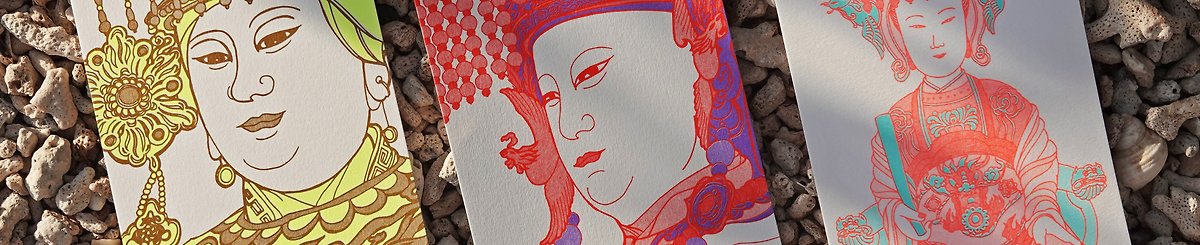
Since 2020, she has been issuing the "Taiwan Mazu Calendar," integrating her hand-drawn Mazu images with letterpress printing, listing Mazu events designated as national or county-level folk cultural assets, bringing Mazu's blessings year after year.
Migrating with the passage of time, she has been creating art in various locations across Taiwan. Through her travels, she perceives the intimate connection between herself, the land, and the environment, and how they mutually support each other. Consequently, her artistic subjects are folk culture and people. Her hand-drawn black and white ink outlines, complemented by photography and writings about her travels, present the simplest form of intuitive perception, expressing the emotional exchange between people and the environment across time and space. Though not formally trained in art, she possesses a unique personal style. These creations are her teachers in finding inner peace and practicing life and art.
Fan Page | Chu's studio
-----
Table of Contents
Foreword: Setting Off, Already on the Way / Yin Bao-Ning (Professor and Dean, Graduate Institute of Arts Management and Cultural Policy, National Taiwan University of Arts)
Preface
PART 1: PURSUIT
"Why don't I go on the pilgrimage with you?" — It all began like this.
"I remember when we first met, you were twenty-five." — The Dajia Mazu Pilgrimage
"This is what Grandma wants you to eat!" — The Baishatun Mazu Pilgrimage to Beigang
"Taking the first step is halfway to success." — A Pilgrimage to Mazu Temples Around Taiwan
"Mazu, please, take a seat!" — My Connection and Dreams with Mazu
PART 2: CREATION
"A pen holds great power." — Hand-Drawn Mazu and the Publication of "The Boat of Salvation"
"It's like Mazu came to my home!" — About the "Taiwan Mazu Calendar" Project
PART 3: RESIDENCY
"Only Grandma can offer me three-in-one coffee." — Residency at the Huangjin Museum of Gold, Ruifang, New Taipei City
"I can tell it's you just by your back!" — Jinbaoli Second Mazu Visits Yehliu
"The first time I heard a prayer recited in vernacular Taiwanese." — Residency in Lugang and Tonight We Pay Homage to the Jade Emperor
"Deities also need the warmth of fire." — Participating in the Mazu Lantern Festival in Matsu and the Market at my Maternal Grandmother's Home
"I felt embraced by Mazu, so touching..." — Residency in Hongluo Village, Penghu County
"You're coming to Chiayi, really?" — Residency in Chiayi, Remembering the Yushan Hostel
PART 4: TRAVEL
"How should I address you?" — I Enshrined a "Ci Yi Mazu" Statue
"With heart, a vow, and action." — Inviting Ci Yi Mazu to Ascend Jiā míng Lake
"How does Mazu take a plane?" — Ci Yi Mazu Visits Bhutan
"We are kindred spirits!" — Five Companions and Ci Yi Mazu on the Shikoku Pilgrimage
Afterword
Taiwan Mazu Festivals
Chusstudio99's Travelogue of Following Mazu
Extended Links
-----
Foreword
Setting Off, Already on the Way
Yin Bao-Ning / Professor and Dean, Graduate Institute of Arts Management and Cultural Policy, National Taiwan University of Arts
This is a foreword, and I am grateful for the opportunity to read it in advance. After the initial reading, I was deeply moved, my emotions still lingering between the lines. I have so much to say, yet I find myself lost amidst such a rich tapestry of life experiences.
Speed is one of the greatest challenges facing our generation. We are accustomed to "zero latency," "instantaneous," and "online" interactions, even demanding "proactive deployment." People are used to and expect a certain pace of interaction and operation, including what our eyes and fingers can reach, leaving no moment of pause. However, this time, escaping the constraints of "immediacy" and "speed," I virtually traveled through over fifteen years of accumulated youth through Zhu Zhu's words. Unlike armchair traveling or traversing time and space with fingertips, Zhu Zhu's narrative depicts a journey that progresses step by step, a personal exploration that also illuminates the ebb and flow of life, like a quiet yet powerful current. While seemingly in constant motion and transition, there is an unyielding, solid, and fearless tranquility. The book is filled with many touching sentences that guide readers onto life's peaceful path: "In the moments of greatest hunger and exhaustion, the warmth of life becomes more profound, sharp, and clear. My enlightenment perhaps came from the way I viewed life; the moment of departure was when Mazu began to travel with me."
The essence of a "pilgrimage" in religion is the embodiment of faith through physical exertion, a form of asceticism that complements spiritual cultivation. Through this walk imbued with faith, seemingly to affirm and seek one's beliefs, it is in fact a search for inner peace and contentment. In this book, starting from joining Mazu's pilgrimage procession in 2008, walking becomes Zhu Zhu's process of contemplation and seeking enlightenment. Walking is realizing the Way. In a world where speed is the goal and value, the ability to slow down, walk deliberately, observe carefully, interact genuinely with others, greet them, converse, share food, and settle and return, as Zhu Zhu does, is a blessing and a joy. Similar to the Shikoku Pilgrimage or the journeys to Jiā míng Lake and Bhutan, within this life trajectory that appears to follow Mazu's guidance, her experiences allow us to reimagine a world of existence with a sense of time, historical depth, and greater richness.
Walking journeys involve continuous movement through space. The Dajia Mazu Pilgrimage and the Baishatun Mazu Pilgrimage are familiar religious activities in Taiwanese society. However, following Zhu Zhu's footsteps, we encounter diverse activities related to Mazu worship across Taiwan, from artist residencies and research projects to various exhibitions in places like Jinguashi, Lugang, Penghu, Jinsan, Yehliu, Chiayi, and Matsu. Beyond the linear timeline, we see spatial images: these short-term stays, initially intended as artist residencies, were, upon closer inspection, not mere passing visits but opportunities for Zhu Zhu to integrate and settle in harmony with her surroundings. Through her detailed descriptions, using Mazu worship as a guide, it represents a younger generation's inward exploration of their culture and history, finding their cultural identity within it.
For instance, her description of how households in Lugang prepare for the traditional "Jade Emperor's Birthday" on the ninth day of the first lunar month showcases numerous details. Zhu Zhu and her friends decided to participate, embodying the process of the younger generation inheriting local memories: "Most of these offerings were purchased from old shops, handmade items, or locally grown produce, utilizing local ingredients from farm to altar, making it especially meaningful." This important ritual concludes with a Lugang proverb: "Three unknowns: unseen sky, unseen earth, unseen women." The densely packed buildings obscure the sky above, and the prosperous town's streets are paved, leaving no soil visible—"unseen sky, unseen earth" describes Lugang's bustling streets; "unseen women" reflects the social landscape where women rarely left their homes. Zhu Zhu, always on the move, uncovers cultural content and learns from folk traditions, simultaneously breaking through traditional frameworks and limitations.
Zhu Zhu seems to be searching for answers to her life's questions through her travels. However, her writing reads more like a process of questioning and learning. The book frequently discusses how life is inherently a journey of learning: learning to accept separation and impermanence, learning to let go, learning the importance of "ichi-go ichi-e" (one time, one meeting), and learning to feel. I appreciate the four-part structure of the book, moving from the initial departure and pursuit, elaborating on her creative drive, the world she observed during her residencies and settled stays in various places, culminating in her travels with Ci Yi Mazu. From departure, through the journey, to return, and then re-examining her life's path. I invite readers to join Zhu Zhu's vivid human narratives and dialogues of shared life experiences within her meticulously depicted scenes—moving sometimes in quiet contemplation, then in deep reflection—to put their hearts at ease and find their own place of solace. Setting life goals may be difficult, and actualizing them even more challenging, but Zhu Zhu's travel narrative teaches us the most important lesson: Setting off, you are already on the way.
-----
Preface
The stories in this book span fifteen years.
"Are you even listening to me?"
It's possible for people to desire solitude; one can feign aloofness, but as humans, denying the importance of being heard is a lie! Perhaps it's not just humans who can hear my inner voice, but also "Mazu"! I never expected Mazu to hear my confessions...
Life's journey is filled with challenges. Things that seem ordinary to others may carry immense weight in one's heart; I call these life's "lessons."
In college, I was troubled by whether to pursue further studies or enter the workforce. The unknown future held too many uncertainties, making it difficult to decide. One afternoon after class, I casually walked into a Mazu temple on Xinzhuang Old Street. The tranquil atmosphere allowed me to shed my usual defenses. Though the divine statue was far from me, I knelt on the prayer mat and murmured to Mazu: "I hope you can clear the clouds and show me the way, guiding me in my life's direction."
As soon as I finished speaking, a warm aura gradually approached from the direction of the shrine, enveloping me. In an instant, it felt as if the darkness of ignorance dissipated, unlocking the key to my soul.
From that day on, I embarked on the path of following in Mazu's footsteps.
From 2008 until I write this (2023), I make sure to set aside time each year to walk with Mazu. Stepping out of my "comfort zone" revealed a much wider world. Mazu's spiritual inspiration unites everyone on the path, moving towards the same direction. The human warmth accumulated from countless small contributions transcends boundaries of region, race, and age. Many fellow pilgrims, diligently pursuing their careers in various fields, coincidentally meet on the road for this unique annual occasion, sharing their experiences and looking out for each other.
After I started participating in the pilgrimages, I dreamed of Mazu several times, which later sparked the idea of drawing Mazu's portraits. In my dreams, she was a towering, radiant golden figure reaching into the clouds. I couldn't quite discern her features, but I heard faint echoes of her words. I believe this was the impetus for me to depict her ever-changing divine forms.
I am someone who enjoys solitude, but to avoid narrow-mindedness while alone, I travel.
Walking around the island is more than just circling it. For me, it's like a prelude to travel, a starting point for broadening my horizons. On these journeys, I meet different people from various places, all quietly striving for their ideals, like scattered stars that are not lonely.
During my treks, I often hurried to make good time, panting and unable to clearly see the ground beneath my feet. Fueled by my curiosity about the land, I began spending more time in villages for residencies, nurturing connections slowly, allowing the stories between people to enrich every chapter of life.
Many people ask me: "How do you keep your heart full and stay true to your original intentions?" When facing insurmountable challenges in life, religion for me is not just about having a deity to worship, but about using the process of rituals for introspection and self-reflection, constantly improving—this is a life lesson. If one does not understand the changes within oneself, how can one comprehend the world around and beyond?
What does it feel like to request a Mazu statue for an artist residency? It might seem unconventional. If not viewed as a religious act, perhaps it could be called "performance art."
With Mazu, I have traveled by plane, high-speed rail, regular train, and ferry to various places in Taiwan, Penghu, Kinmen, and Matsu. Are there any inconveniences when traveling? I consider that Mazu should maintain a certain dignity even when traveling. Despite my limitations as one person, I ensure she is not alone in her seat, and I prepare meticulously to ensure her comfort upon reaching our destination, such as when needing to use the restroom.
With a sense of novelty and curiosity towards the unknown, and an seemingly innate adaptability—"You seem to blend in easily with everyone," a friend once commented—I have ventured out on many long journeys. I have carried Mazu up "the Tears of Heaven" Jiā míng Lake, Mount Xiangyang, and Mount Sancha, one of the Hundred Peaks. I traveled as far as Bhutan, a small kingdom in the Himalayas, and to the northernmost region, Japan's Shikoku, following in the footsteps of Kōbō Daishi for a nearly month-long self-guided pilgrimage.
Inspired by the "Goshuin" (temple stamps) from the Shikoku Pilgrimage, I applied the concept to my Mazu art collection, "The Boat of Salvation." Mazu has accompanied my creative endeavors and travel plans, visiting numerous places. "Traveling the world, huh!" a psychic I met for the first time remarked with a knowing smile upon seeing Mazu.
Japan has well-developed cultural path narratives and overall activity planning, which have endured for thousands of years. Taiwan's Mazu activities are deeply intertwined with local development and are listed as numerous national folk customs and intangible cultural heritage. Since 2020, I have combined my Mazu illustrations with the lunar dates of annual and regular events to create the "Taiwan Mazu Calendar." This not only motivates me to produce new works but also serves to continuously document Mazu stories hidden in the streets and alleys. While they may not be nationally renowned, they represent the guardianship of their respective regions, leaving unique Mazu imprints across Taiwan with each step.
From feeling cared for to receiving guidance on my life's path, I self-published my island-wide travelogue "Nai Jing: Zhu Zhu's Island-Wide Trekking Diary" in 2014, documenting my experiences following Mazu's pilgrimage and traveling around the island. In the following years, I participated in residencies in various places according to the seasons, encountering more people and stories. Ten years have passed in the blink of an eye, accumulating more energy. As time goes by, my thoughts become more thorough, and my mindset more mature.
One afternoon, I messaged editor Xiao Ou about publishing this book. I met Xiao Ou at a traveler's lecture. She walked the Shikoku Pilgrimage in Japan, following in the footsteps of Kōbō Daishi, while I trekked around Taiwan seeking Mazu's sacred sites. Traveling between Taiwan and Japan, I felt a kindred spirit among fellow walkers. The publishing plan was quickly settled, but organizing the emotions and stories of these fifteen years proved to be the real challenge.
Recalling many events, I realized that what I couldn't comprehend back then had already been resolved through my step-by-step journey. With a final, comprehensive effort, I wrote "Accompanying Mazu: An Artist Zhu Zhu's Practice of Faith and Life," intending to capture fleeting moments from my life's journey, leaving behind stories worth savoring and reminiscing about in ten or twenty years. From traveling with Mazu to Mazu traveling with me, forging good relationships in various places, and accumulating a rich depth of life experience—things I never anticipated when I first confided in Her.
"Did you encounter a major setback that led you to rely on faith?" someone once asked me.
Following Mazu on pilgrimages, then traveling extensively, and documenting my life's journey through integrated knowledge and action is not just about faith; it's also about my affection for the sea and the land, with the hope of forming good relationships and broadening my horizons. In reality, worldly worries are quite numerous. Sometimes, just as a journey begins, I worry about where the money will come from.
Only after enduring hardship and pain do we truly cherish. I am not alone on this path; I must continue forward despite the difficulties. Yearning for an ideal world, I ventured out to see the outside world. With an open mind, one is no longer bound by temporary life struggles. Living contentedly, even without great wealth, and moving forward with fulfillment is a form of sustenance and treasure stored in the bank of life.
How far can one go in life? Traversing ten thousand miles just to reach the ends of the earth. In the process of searching for a path, one may not necessarily find an answer. Appreciating the scenery encountered along the way, or forging a new path, might be an opportunity for sudden enlightenment.
No coming, no going, no worries. Life is indeed a bit difficult; letting go of worries requires learning. Being able to pick up and put down, the simplest answer is, "I followed Her, and learned to let go of my worries; with Mazu listening, I am willing to share my life, my heart with Mazu."
Someone asked me, "Mazu never gave birth, how can she be called Holy Mother?"
"Mazu is a collective noun that encompasses compassion and empathy, regardless of gender or age, whether as a deity or a believer, embodying a shared humanity," I replied.
"I have received so much from others, and therefore I thank Heaven." I thank Mazu for leading me on my life's path, for being my "Heaven."
In this life, "ichi-go ichi-e" (one time, one meeting). From yearning for foreign landscapes to delving into Taiwan's cultural context and my own inner reflections, "the spiritual mountain is within your heart." The present moment is all there is; no need to search in distant lands.
I humbly dedicate this book to all fathers and mothers in the world, and to all men and women who possess a benevolent heart capable of salvation.
-----
ISBN:9991130325013
Series: Mark
Specifications: Paperback / 272 pages / 14.8 x 21 x 1.45 cm / Normal Grade / Monochrome Printing / First Edition
Publication Place: Taiwan


รายละเอียดสินค้า
ข้อมูลสินค้า
- วัสดุสินค้า
- กระดาษ
- วิธีการผลิตสินค้า
- ผลิตโดยโรงงาน
- แหล่งผลิตสินค้า
- ไต้หวัน
- จำนวนในสต๊อก
- มากกว่า 10 ชิ้น
- อันดับสินค้า
- No.70,476 - เครื่องเขียน | No.2,257 - หนังสือซีน
- ความนิยม
-
- ถูกชม 3,929 ครั้ง
- จำหน่ายไปแล้ว 5 ชิ้น
- มี 14 คนถูกใจ
- สินค้าที่จำหน่าย
- สินค้าต้นฉบับ
- รายละเอียดย่อยของสินค้า
- Through her words, Zhu Zhu revisits the landscapes encountered and the paths trodden over fifteen years of accompanying Mazu. She recounts the people met and the stories woven, highlighting how faith can be a way of life and a practice of existence, both enduring and substantial.
ค่าจัดส่งและรายละเอียดอื่นๆ
- ค่าจัดส่ง
- วิธีชำระเงิน
-
- บัตรเครดิต/เดบิด
- อินเตอร์เน็ตแบงก์กิ้ง/โมบายแบงค์กิ้ง
- เคาน์เตอร์เซอร์วิส
- ตู้เอทีเอ็ม
- เคาน์เตอร์ธนาคาร
- Alipay
- การคืนเงินและเปลี่ยนสินค้า
- อ่านรายละเอียดการคืนเงินและเปลี่ยนสินค้า
- แจ้งปัญหา
- รายงานสินค้าชิ้นนี้