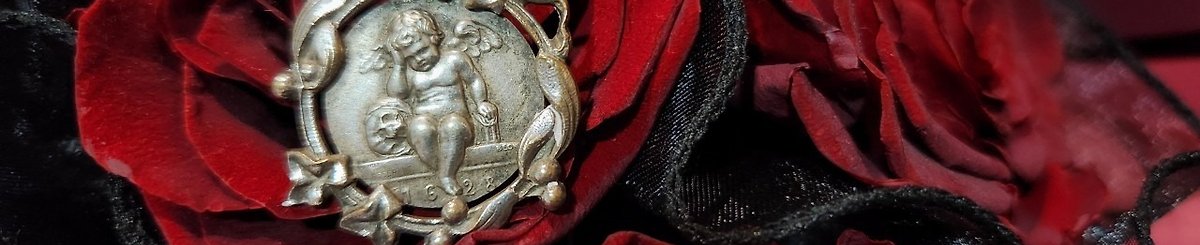

A rare, large, hand-hammered brass and amethyst antique necklace from the early 20th century, acquired from an antique shop in England.
Art Deco, a style of visual art, architecture, and design, first appeared in France before World War I. Art Deco influenced the design of architecture, furniture, jewelry, fashion, and automobiles, among other things. Art Deco is a mixture of many different styles, sometimes contradictory, but united in their pursuit of modernity. From its inception, Art Deco was influenced by the bold geometric forms of Cubism and the Vienna Secession, the vibrant colors of Fauvism and the Ballets Russes, the latest craftsmanship in furniture from the Louis Philippe I and Louis XVI periods, and the exotic styles of Chinese and Japanese, Indian, Persian, ancient Egyptian, and Mayan art. The Chrysler Building and other skyscrapers built in New York in the 1920s and 1930s are monuments to the Art Deco style.
Department stores and fashion designers in Paris also played an important role in the rise of Art Deco. Established companies including luggage maker Louis Vuitton, silverware company Christofle, glass designer René Jules Lalique, and jewelers Cartier and Boucheron began to design more modern products. Starting in 1900, department stores recruited Art Deco artists to work in their design studios. The decorative work for the Autumn Salon of 1912 was commissioned to the department store Printemps. In the same year, Printemps created its own studio, "Primavera." By 1920, Primavera employed more than 300 artists. The style of these furnishings ranged from improved versions of Louis XIV and Louis XVI, especially Louis Philippe furniture made by Louis Süe and Primavera, to more modern styles such as those from the Louvre Department Store studio. Other designers, including Émile-Jacques Ruhlmann and Paul Foliot, rejected mass production and insisted that each piece be handcrafted individually.
In Western cultures, purple also represents nobility and has long been a favorite color of royalty. This stems from the fact that the purple dye, commonly used by the Tyrians in the Roman Empire, was exclusively for the nobility. Garments dyed in this color were close to crimson and were highly favored by the monarchs of the time. During the Byzantine era, emperors from the direct royal lineage would add "Born To The Purple" to their titles, signifying their legitimate birthright, distinguishing them from monarchs who acquired the throne through other means.
The dream of purple is filled with romance and fantasy, evoking contemplation and nostalgia. Purple is also a color often favored by young girls in their prime, as it expresses a unique charm and allure. Purple is a feminine color—beautiful and poetic, leaving a profound impression. It also represents strong emotion, hence the saying "Purple passion." Purple love is noble and pure, unconcerned with worldly wealth. Perhaps only an irreplaceable true love from the heart can touch it. Purple love is passionate love hidden within coolness, perhaps like the fox in The Little Prince, waiting for its prince to appear and then following his footsteps out of its den. Or perhaps it is a love destined to be spent in waiting.
![Rare Large Art Nouveau Brass Amethyst Hand-Chased Floral Antique Necklace [Graduation Gift] Mother's Day Gift - สร้อยคอ - เงินแท้ สีทอง](https://cdn01.pinkoi.com/product/aTJ98ENZ/0/1/1080x0.avif)


รายละเอียดสินค้า
ข้อมูลสินค้า
- วัสดุสินค้า
- เงินแท้
- วิธีการผลิตสินค้า
- แฮนด์เมด
- แหล่งผลิตสินค้า
- สหราชอาณาจักร
- จุดเด่นของสินค้า
- บริการสั่งทำพิเศษเฉพาะลูกค้า
- จำนวนในสต๊อก
- เหลือเพียง 1 ชิ้น
- อันดับสินค้า
- No.179,828 - เครื่องประดับ | No.41,144 - สร้อยคอ
- ความนิยม
-
- ถูกชม 2,467 ครั้ง
- มี 17 คนถูกใจ
- สินค้าที่จำหน่าย
- ของเก่าวินเทจ
- รายละเอียดย่อยของสินค้า
- A rare, large, hand-hammered brass and amethyst antique necklace from the early 20th century, acquired from an antique shop in England.
ค่าจัดส่งและรายละเอียดอื่นๆ
- ค่าจัดส่ง
- วิธีชำระเงิน
-
- บัตรเครดิต/เดบิด
- อินเตอร์เน็ตแบงก์กิ้ง/โมบายแบงค์กิ้ง
- เคาน์เตอร์เซอร์วิส
- ตู้เอทีเอ็ม
- เคาน์เตอร์ธนาคาร
- Alipay
- การคืนเงินและเปลี่ยนสินค้า
- อ่านรายละเอียดการคืนเงินและเปลี่ยนสินค้า
- แจ้งปัญหา
- รายงานสินค้าชิ้นนี้