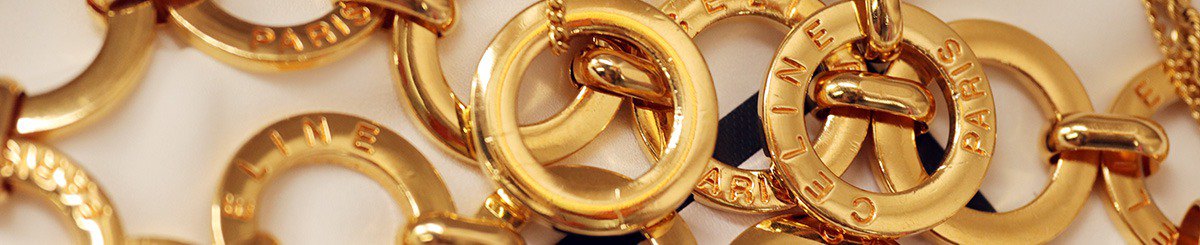

Celine vintage handkerchief (⁎⁍̴̛ᴗ⁍̴̛⁎), 100% authentic pre-owned vintage item!
If you have any questions, please message before placing an order. All sales are final.
Purchasing this item as an add-on to a pre-owned bag order will significantly reduce the price. Please contact me before placing your order for a price adjustment.
It might not be widely known that many brands produce exclusive, licensed products specifically for the Japanese market.
If you've traveled to Japan, you'll know that department stores are filled with unique souvenirs. I'm not talking about the food basement levels, of course!
On the upper floors, you'll find special items produced under license from various brands, exclusive to Japan and often unavailable even through the brand's main sales channels.
For example, in earlier times, Celine licensed several Japanese textile companies to produce a range of textile goods, including various home and lifestyle items, which are incredibly practical.
These were sold at very accessible prices, making them perfect for both gifting and personal use, with a price point vastly different from the brand's official boutiques.
However, Celine's licensing agreements with Japanese companies have long since expired, so you won't find these items even if you visit Japan now.
These are all Japan-exclusive items that have been out of production for many years, much like pre-owned bags. Each one is a rare find!
A little side note: the reason for these licensed products back then was that luxury brands began to focus on the Asian market. Japan's economy was booming, and it was likely the most affluent market in Asia at the time. As brands entered Japan, they made various arrangements to accommodate local culture.
The Japanese gifting culture is extensive; as seen in Japanese dramas, people there frequently exchange gifts.
Japan already had many factories producing products suited for various gifting occasions, with mature techniques and unique offerings.
This led many brands to enter into licensing agreements with Japanese companies for production. These gift sets were typically sold only in department stores and were very popular in Japan due to their appealing presentation. Having a "brand" name made them suitable for gifting to relatives, friends, or superiors.
.
.
.
⚐⚑˒˒CELINE large square handkerchief. Each piece is unique and available in limited quantities. Once sold, it's usually impossible to find the same one again!
Most still have their original stickers attached (if present, they are shown in the photos). Some may be missing the sticker, but all are brand new and unused, perfect for gifting or personal use. Sizes range from 45-55CM.
Purchasing this as an add-on to a pre-owned bag order offers a significant discount. The add-on price is truly exceptional. Please message me before placing your order for a price adjustment.
Regarding handkerchiefs, most customers in mainland China, Hong Kong, and Taiwan likely used them more frequently in childhood, switching to tissues as they grew older.
However, the Japanese handkerchief culture (yes, it has evolved into a culture) is deeply ingrained from childhood to adulthood and has never changed!
In Japan, whether it's children, adults, or the elderly, a handkerchief is a standard item to carry, driven by various factors, likely including environmental consciousness, decorum, and politeness.
You can find more details online; I won't elaborate too much. In short, if you live in Japan and don't carry a handkerchief, you're likely not Japanese.
Japanese handkerchief production techniques are exceptionally high. Don't underestimate these small pieces of fabric; upon closer inspection, you'll find exquisite details that will amaze you!
Examples include two-tone double-sided embroidery, hidden embroidery, the use of subtly different colored threads to create a lustrous effect, gold and silver foil stamping, colored foil stamping, and more.
There's also a wide variety of materials, from soft cotton gentle enough for a baby to breathable linen perfect for summer that dries quickly.
The patterns are not only intricate, but the details are such that they won't fade even after many washes. Even the foil stamping won't lose its sheen!
Many are so beautiful they resemble works of art and can even be framed for decoration. The most crucial point is that many of these techniques are unique to Japan.
Even the more expensive silk scarves produced in Europe by the brands today don't feature as many intricate details as a single small Japanese handkerchief.
But you might ask, "What can I do with a handkerchief if I don't use it for personal hygiene?" The uses for handkerchiefs extend far beyond wiping your mouth or sweat. They can be used as decorative accessories! You can hang them on or tie them to your bags. This is an excellent habit for luxury and pre-owned bags, especially vintage ones. Their greatest value isn't their price but their increasing rarity in the world. Therefore, using them should involve a habit of protection. Hanging one on your bag adds a small decorative touch, while tying one to a strap can directly protect the most frequently used and easily worn areas, keeping them clean and preventing accidents.
I personally experienced this once when someone next to me at a workshop accidentally spilled dye on their bag strap. Fortunately, I had the habit of tying a scarf to my strap! My bag was saved, although the scarf had an ink stain that wouldn't wash out... but I'd much rather it be the scarf than the bag strap!
Handkerchiefs can also be used to adjust the length of overly long straps (I can show you how). My most frequent use is for home decor.
I've long had the habit of using large scarves or handkerchiefs to cover idle decorative items at home, primarily for dust protection. My home gets very dusty, and anything left untouched for two days develops a thin layer of dust. When the cover cloth gets dusty, I simply take the whole thing to the wash, which is convenient.
Covering items with plain fabric or handkerchiefs can look a bit odd (like an unoccupied home with covered furniture)... which is why I've always used scarves to cover things around the house.
The uses for handkerchiefs and scarves are truly endless and personal. In any case, having one or two of these small accessories is not a problem. When folded into small squares, they don't take up much space in your bag and can be used in any unexpected situation, even for wiping your bag or yourself on a rainy day.
If you purchase a handkerchief as an add-on to a pre-owned bag order, you'll receive a special price. Please message me before placing your order for a price adjustment.
❍ The photos are taken by the owner under natural sunlight. Lighting may vary depending on the time of day, and color variations are possible.
Each handkerchief has unique details and unfolded views, but they cannot all be displayed here. Please message me to request them. Due to the unique nature of pre-owned orders, all sales are final. Therefore, please examine the photos carefully before purchasing.
⋄┈┈┈┈┈┈┈┈⋄⋄⋄┈┈┈┈┈┈┈┈⋄
| Rating | Brand New, Unused
| Size | Square, 45-55cm
| Color | /
| Material | Cotton
| Origin | Japan
⋄┈┈┈┈┈┈┈┈⋄⋄⋄┈┈┈┈┈┈┈┈⋄
The main reason I love pre-owned bags is that the materials from earlier eras are vastly superior to those in modern new items.
In the past, most pre-owned items were handmade ✦, imbued with the warmth of craftsmanship before mass production.
Artisans' skills were far more delicate than machines, just as everyone appreciates items handcrafted by skilled artisans!
However, today, the vast majority of processes are mechanized with minimal human assembly, losing the subtlety of the past.
The simplest and most direct way to see this is to compare the detailed patterns of modern brands' reissued classic motifs with the genuine classic patterns from older eras. The level of detail in the patterns alone is entirely different. If you love classic patterns, you must look for pre-owned items! Truly!
In terms of style, older pieces were more ✦ simple, timeless, and enduring. Many current new designs are actually remakes of older styles.
However, new items are priced higher than older ones. New designs are typically based on older models, with added details or modifications.
The final product often ends up being more complex (or strange...) than its predecessors. As we grow older, we realize that the simpler, the more enduring! As we age, our clothing choices often return to basic styles because the more fundamental, the more versatile.
The quality of raw materials in older pieces is also superior to newer ones. Anyone who understands ✦ leather can see that the materials used in new items are mostly inferior to older ones.
This is mainly because the cost of high-quality raw materials is too high today, and their availability is less than before. Earth's resources are dwindling!
Furthermore, brands back then didn't have the "ubiquitous" presence of numerous branches like they do now. Most customers had a certain income level and high expectations for the finished products. There was no "fast fashion culture" back then; a bag was expected to be used for many years.
The difference between new and old eras is clearly visible in the ✦ hardware. The hardware on many new items oxidizes and discolors after just one or two years, but older pieces typically do not. Besides the use of high-quality materials and meticulous craftsmanship, the hardware in earlier eras was plated with real K gold!
It's worth mentioning that Chanel Vintage is expensive for a reason; many of its clasps and chains contain real gold, certified by gold merchants!
Therefore, even Vintage bags from as early as the 60s and 70s, if properly preserved, can still have gleaming hardware today.
For new items available now, based on my knowledge of brands, none have K gold in their hardware, making them prone to oxidation.
Many say that buying Vintage bags is a form of alternative investment, as they rarely depreciate and tend to appreciate in value. This is because the number of well-preserved pre-owned bags on the market is decreasing, and each one that disappears is one less. Remember, each of these is a discontinued item. The number that exists in the world is finite, so they will only become fewer, more expensive, and harder to find.
Moreover, many brands periodically increase their prices, and each increase drives up the market price for pre-owned items.
If a brand releases a "reissue," the reference or similar styles in Vintage will also see a sharp price increase!
Adding to this, the recent popularity of vintage items among Korean and Japanese celebrities causes prices to skyrocket once a particular item is seen on a celebrity. The demand surges, leading many people to frantically search for that item or a similar alternative, causing the prices of those few items to multiply...
Therefore, Vintage is truly a case of "buy early, enjoy early; buy late, pay more" (this isn't an advertising slogan... it's a truth in the pre-owned world...).
This is my personal experience; I regret not acquiring many series earlier, as they are now impossible to find, or if found, they come with an astronomical price tag...
But the problem is, even knowing the price is astronomical, you're forced to buy because waiting will only mean a higher price (unless the condition is poor).
I am often asked about bag maintenance (ᐢ.ˬ.ᐢ). I will include a small note with details inside the bag, so don't worry.
My personal habit is to take them out for maintenance when I organize my closet during seasonal changes (so each seasonal change is a major undertaking... |||).
Pre-owned bags are not that troublesome. When you're new to it, you just need to get into the habit of regular maintenance and cherishing your bag. Once you form the habit, it's not difficult.
The materials of pre-owned bags are inherently excellent. As long as you don't use them roughly and preserve them properly, they can easily last another ten years and be passed down to your daughter!
Every pre-owned bag is one I love and have collected, so I hope you will love it too and be able to preserve it for years to come ☪︎ *.。
☾︎.*·̩͙ If you are interested in purchasing, please feel free to message me with any questions. I am looking for discerning buyers who appreciate pre-owned items ⸜❤︎⸝.
⚜️ All copyrights and trademarks belong to the brand of this product. ⚜️


รายละเอียดสินค้า
ข้อมูลสินค้า
- วัสดุสินค้า
- ผ้าฝ้าย/ผ้าลินิน
- วิธีการผลิตสินค้า
- ผลิตโดยโรงงาน
- แหล่งผลิตสินค้า
- ญี่ปุ่น
- จำนวนในสต๊อก
- เหลือเพียง 1 ชิ้น
- อันดับสินค้า
- No.100,789 - ของตกแต่งบ้าน | No.3,681 - อื่นๆ
- ความนิยม
-
- ถูกชม 6,480 ครั้ง
- จำหน่ายไปแล้ว 2 ชิ้น
- มี 15 คนถูกใจ
- สินค้าที่จำหน่าย
- ของเก่าวินเทจ
- รายละเอียดย่อยของสินค้า
- All pre-owned items are from my personal collection ( ᴗ̤ᴗ̤ )*. Each pre-owned bag is personally photographed, 100% as pictured. Please message me with any questions before purchasing. As pre-owned items are unique, all sales are final. 𓂃 𓈒𓏸❁⃘
ค่าจัดส่งและรายละเอียดอื่นๆ
- ค่าจัดส่ง
- วิธีชำระเงิน
-
- บัตรเครดิต/เดบิด
- อินเตอร์เน็ตแบงก์กิ้ง/โมบายแบงค์กิ้ง
- เคาน์เตอร์เซอร์วิส
- ตู้เอทีเอ็ม
- เคาน์เตอร์ธนาคาร
- Alipay
- การคืนเงินและเปลี่ยนสินค้า
- อ่านรายละเอียดการคืนเงินและเปลี่ยนสินค้า
- แจ้งปัญหา
- รายงานสินค้าชิ้นนี้